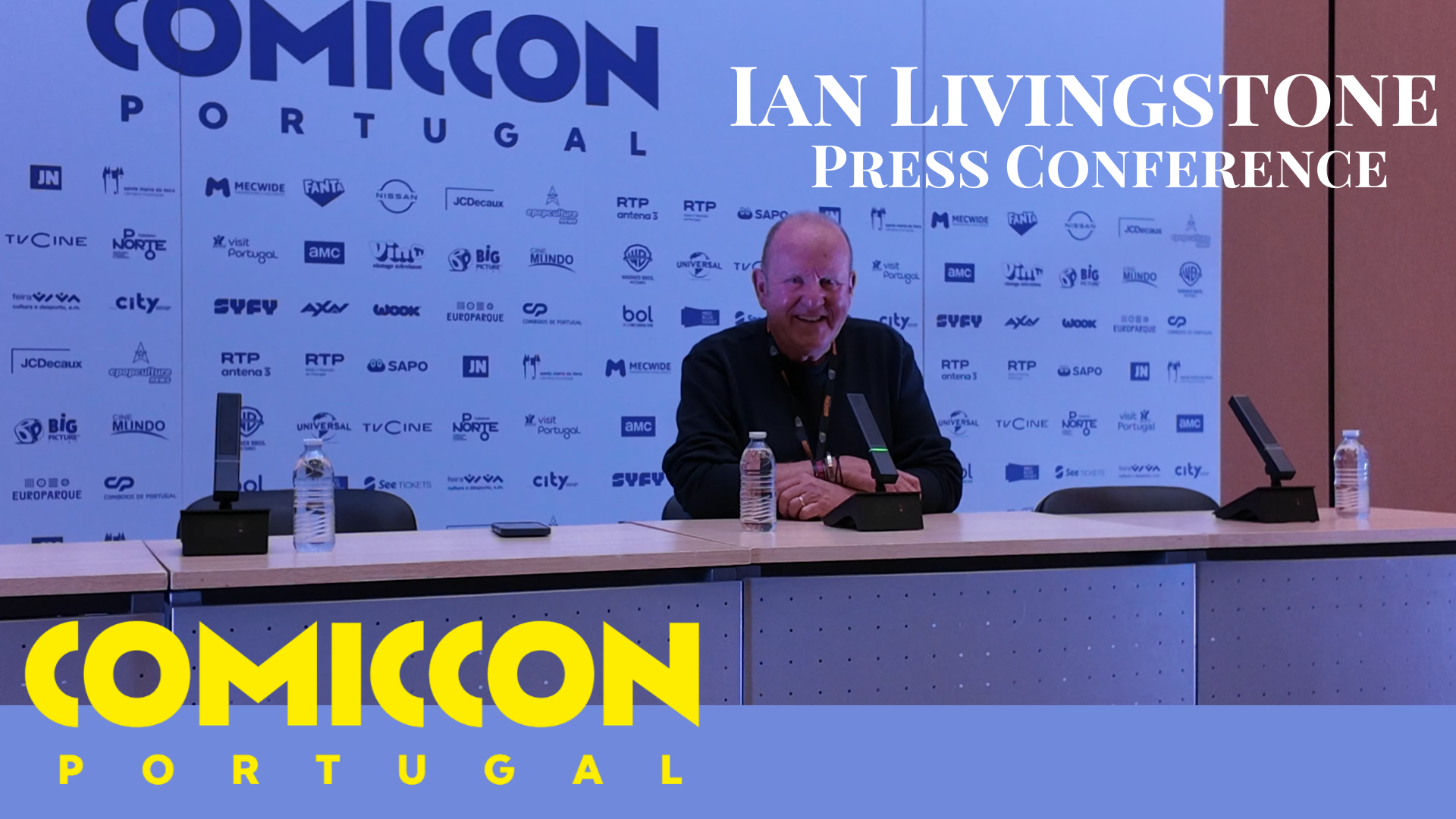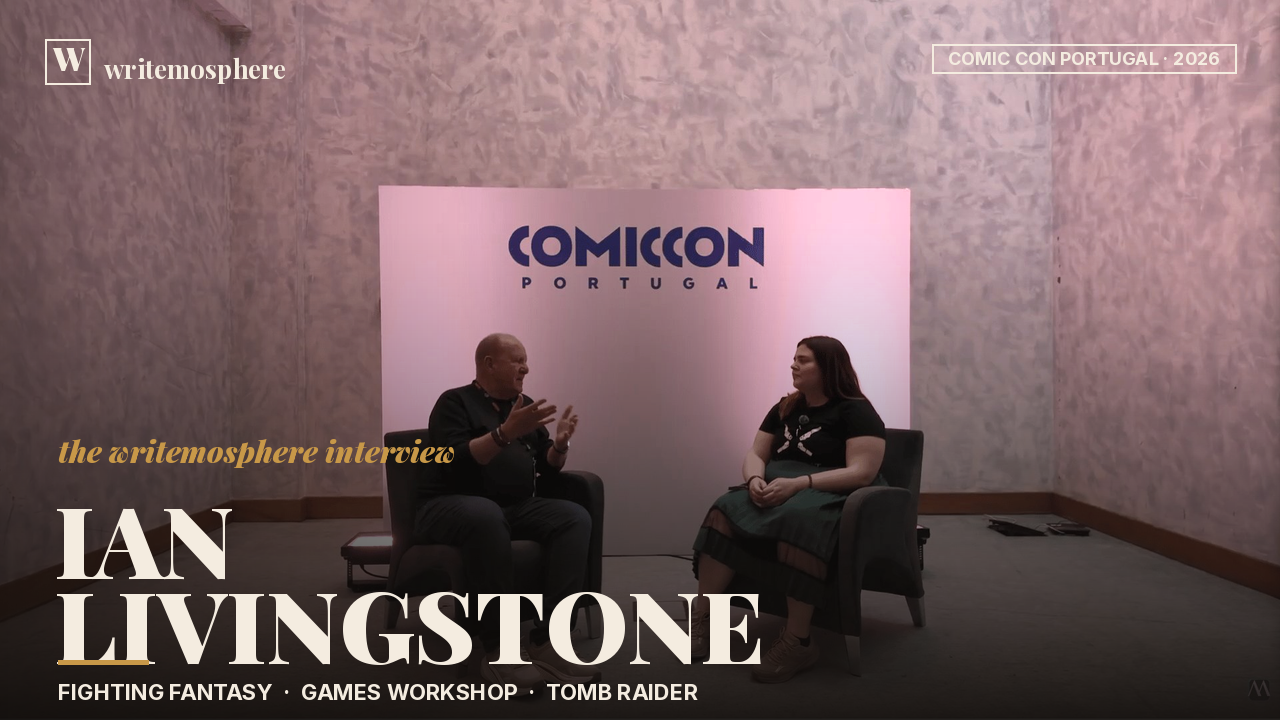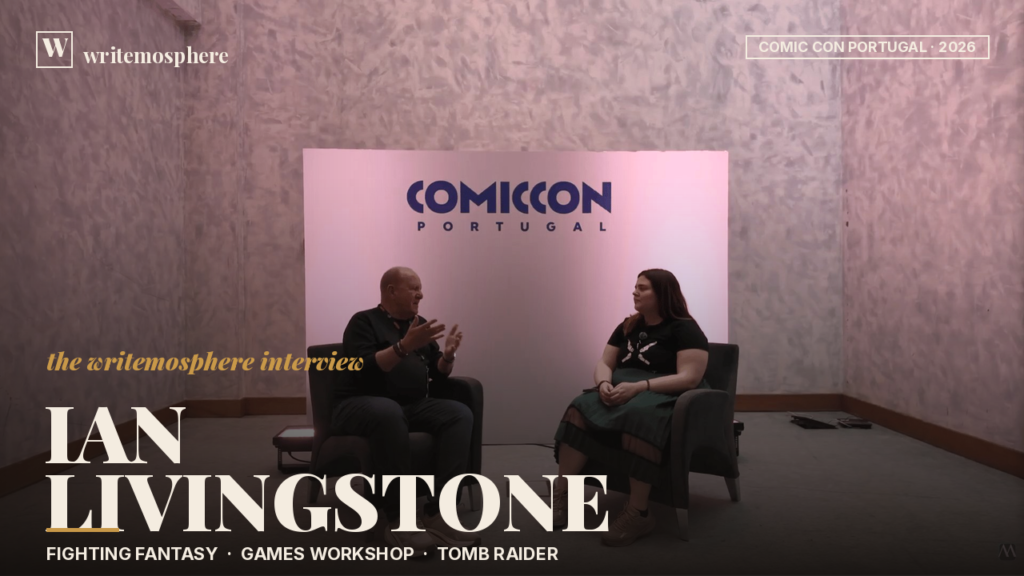
Ian Livingstone, co-founder of Games Workshop and co-creator of the Fighting Fantasy gamebook series, was at Comic Con Portugal 2026. I sat down with him for a one-on-one interview after the press conference. We talked about the writing process behind interactive narratives, the panicked yes that started it all, and why failure is the most generous thing you can give a reader.
Fifty years into a career that helped define modern gaming, Ian Livingstone still writes interactive adventures the same way he did in the 1980s.
“I haven’t changed in all these years. I’ve never used software for constructing the branching,” he said, when I asked him about his process. “I used to write them with a pen, I now use a word document, but apart from that, the way I construct them is the same.”
For a man who has shipped over twenty million books across the Fighting Fantasy series, who launched Dungeons & Dragons in Europe in the late 1970s, and who produced the original Tomb Raider in 1996, the consistency is striking. Whatever modern writers think they need to manage interactive complexity, Livingstone has been quietly demonstrating you can do it with the simplest possible tools. The discipline is in the structure, not the software.
The flowchart that runs everything
What looks simple on the page is, by his own admission, a nightmare to build.
“You start off with a story arc, a mission, a quest, usually set in my world of Allansia,” he explained. “It’s like creating a flow chart. Reference one, you write on the flow chart and it goes to over here with the choices to 270 and 33. It will expand exponentially unless you bring it back in.”
This is the core craft problem with branching narrative, and most writers underestimate it. Each decision the reader makes opens two or three alternatives. Each of those opens two or three more. By page ten, an undisciplined gamebook is already an unmappable mess. The art is not in the proliferation of choices. The art is in herding them back together without making the reader feel railroaded.
“I didn’t realise how difficult, well, a nightmare it was, writing an interactive game book,” he admitted. “Because you’re not writing one story, you’re writing several stories.”
For any writer working in non-linear forms, whether interactive fiction, episodic narrative, or even hypertext essays, this is the lesson. You’re not writing the path the reader will take. You’re writing every path they could take, and trusting that the structure will hold whichever one they pick.
The yes that came before the panic
The origin of Fighting Fantasy is more accidental than fifty years of fame suggests. In 1981, Livingstone and his co-founder Steve Jackson were running a Dungeons & Dragons demo at an event in London called Games Day. An editor from Penguin Books, named Geraldine, walked up to their booth and asked them to write a book about role-playing games.
“Steve and I said, well, why don’t we write a book that allows you to experience a role playing game without needing a Dungeon Master?” Livingstone said. Geraldine agreed on the spot. They scheduled a meeting.
“We left the event and thought, what have we done here? We don’t know what we’re doing.”
What they wrote in the panic that followed became Warlock of Firetop Mountain. It sold millions, spawned a series, and quietly inspired a generation of game designers, novelists, and computer game developers who grew up rolling dice and turning to page 270.
The pattern is one most working writers will recognise. The opportunity arrives before you feel ready. The yes comes out of your mouth before your brain has caught up. The work begins in a state of mild terror. And the project that defines your career turns out to be the one you said yes to without knowing how.
The 17% that nobody expected
When Fighting Fantasy first reached British schools in the early 1980s, it was met with moral panic. Parents wrote concerned letters. Some publishers issued warning guides about the ghouls and demons inside. The books were, in some quarters, treated as a corrupting influence on children.
The teachers, who actually watched students engage with the books, came to the opposite conclusion. Studies from the era reported up to a 17% increase in literacy rates among children reading Fighting Fantasy. Kids who had refused to read suddenly couldn’t put these particular books down.
I asked Livingstone how he found out that giving children dice and making them fail would turn them into better readers.
His answer is the line that stayed with me longer than anything else from the interview.
“It’s the empowerment of choice. You, the reader or the hero in Warlock of Firetop Mountain, this is all about you. It’s not a passive experience, it’s an interactive experience. Participation leads to achievement. Children have a great sense of self-worth when they eventually get through. And failure is no bad thing. It’s just success work in progress. You learn through failing.”
Failure as success in progress.
If you write for or about creative people, that line is worth pinning above your desk. Most of the productivity advice the internet shoves at writers is structured around the avoidance of failure. Optimise your output. Streamline your process. Don’t waste time on drafts that won’t work. Livingstone’s whole career argues the opposite. The point is not to avoid the failure. The point is to make the failure participatory, the failure recoverable, the failure something that teaches the reader how the world works rather than punishes them for not knowing.
It’s a generous philosophy, and it explains why the books sold so well. Children sense generosity. They sense when a book is on their side.
A gateway to interactive entertainment
At the press conferenceright before, Livingstone mentioned, almost in passing, that Hidetaka Miyazaki had publicly attributed his inspiration for Dark Souls and Elden Ring to the Fighting Fantasy gamebooks.
“It’s Miyazaki who made Dark Souls and Elden Ring. He attributed our game books to inspiring him,” he said. “Kind of like almost a gateway drug to interactive entertainment.”
For anyone who has spent fifty hours dying at the same boss in Elden Ring, the design lineage is suddenly very obvious. The principle that animates a Fighting Fantasy gamebook (failure as participation, choice as empowerment, achievement built on top of repeated death) is the same principle that animates the most influential video game of the last decade. Livingstone had it figured out in 1982. The rest of the industry caught up forty years later.
This is also why the Word doc detail matters. The medium did not need to change for the philosophy to spread. The philosophy was always portable.
And there is a new book
UPDATE (05/09/26): Ian Livingstone revealed his next Fighting Fantasy book at the press conference. [Read the announcement and watch the video here ]
For readers who came up on Fighting Fantasy and have been wondering whether new entries are still coming, the answer is yes. At the press conference, Livingstone announced the title of his next gamebook for the first time. It is called Tomb of the Golden Skull, set further south in his world of Allansia, in the regions of Arantis and the Snakelands. The release is scheduled for 27 August. The cover art comes from Karl Kopinski.
It has been, as he put it, a strange privilege. Fifty years in, and he is still writing about the same world, the same way, with the same tools. Still telling several stories at once on a flowchart that started as a pen drawing. Still asking the reader to fail and learn and try again.
If you are a writer reading this, that is probably the most useful thing here. The tools do not have to change. The philosophy does not have to change. The work just has to keep happening.
For the Portuguese-language gaming-focused version of this article, with more on the Tomb Raider years, the Hollywood adaptation critique, and the Miyazaki connection in greater depth, see the parallel piece on MoshBit Gaming.